How to Find a Roof Leak in a Warehouse
Drips and stains are marked on a floor plan, then matched to roof areas above and upslope, since water runs along the deck before it falls. Dates and weather for each stain help too.

Leak Tracing First
As a Bridgeport commercial roof leak repair contractor, we find where water actually enters a roof, confirm it, and repair that spot.
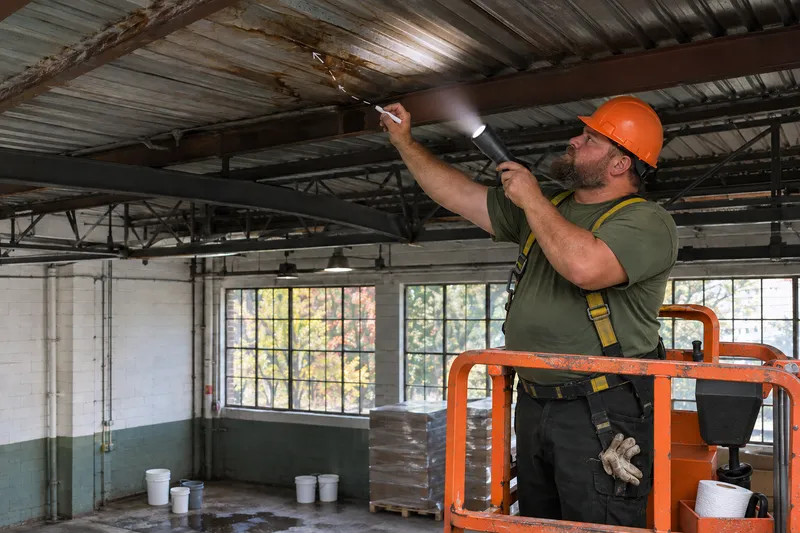
Bridgeport commercial roof leak repair is the starting point when you see water but not the cause. Match your situation below.
| What We Do MostLeak Tracing and Repair | Known Damage Repair | Roof-Wide Problem | |
|---|---|---|---|
| What you see | A stain with no clear cause above it | A visible split, hole, or loose panel | New stains every storm in new places |
| Source | Somewhere upslope, to be traced | Visible on the roof | Many seams or the whole membrane |
| First step | Map stains inside, trace on the roof | Repair the damage, check nearby | Moisture survey across the roof |
| Outcome | Source confirmed, then repaired | Patch or panel repair | Findings shown, larger plan discussed |
Tracing first keeps the repair at the real entry point. A stain that moves storm to storm usually means more than one source, and each gets confirmed.
Water rarely drips straight down from where it enters. These are the five places we trace leaks back to most.
Open coping joints and failed counterflashing let wind push rain into the wall. It shows up inside along the wall line, often a bay away.
A seam sitting in a ponding area stays wet long after rain. Even a small opening there feeds steady water to the deck.
During a downpour, a slow drain lets water rise above flashing. The leak appears only in heavy storms, which makes it hard to catch.
Cracked curb corners and loose unit panels let rain into the curb itself. Condensate lines dripping on the roof add more wear.
Meltwater trapped behind ice at edges and drains sits against seams for days and finds openings that summer rain misses.
Tracing comes before cutting. These four tools find the source so the repair goes in the right place.
Drips and stains are marked on a floor plan, then matched to roof areas above and upslope, since water runs along the deck before it falls. Dates and weather for each stain help too.
A meter swept across the roof shows where insulation holds water, which narrows the search and sizes the repair before anything is cut.
Small cuts through the roof confirm wet insulation and show the layers below. Each one is patched closed before we move on.
Water is run on one area at a time while someone watches inside, so the source is confirmed rather than guessed.
The left column is how a leak shows up inside. The right column is what changes once the source is found and fixed.

Moving stains mean water is traveling along the deck. Call and we will trace it back to where it gets in.
Get A Free EstimateFive steps take a leak from a stain on a tile to a repaired detail on the roof.
Inside, every stain, drip, and wet tile goes on a sketch of the floor plan, with dates and the weather when each one appeared.
On the roof, we check every seam, curb, drain, and flashing above the marks and uphill from them, where water starts its run.
Moisture readings, a core cut, or a controlled water test on one area at a time prove the entry point before any repair.
The entry point is repaired with matching material, and wet insulation around it is replaced so it stops feeding the stain.
Ask your staff to check the old stain after the next heavy rain. A dry tile confirms the repair; a damp one sends us back up.
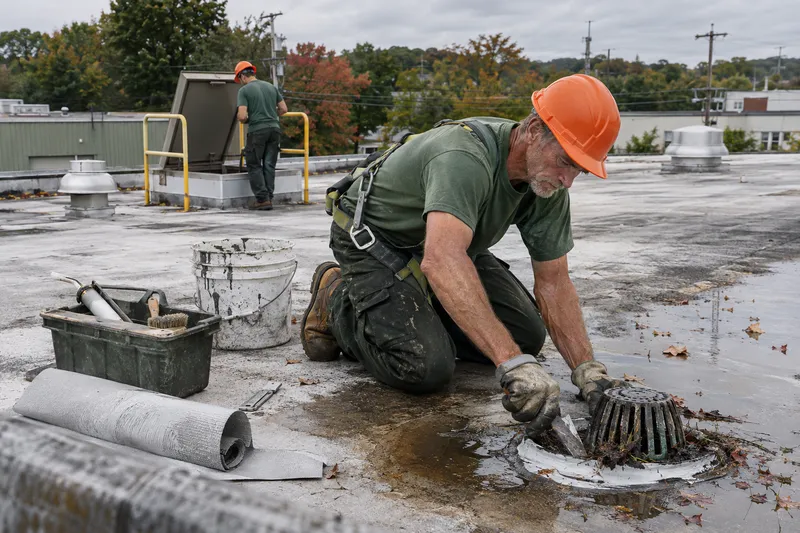
Many traced leaks end at a flat roof seam, drain, or base flashing, which then gets a matching membrane repair.
See flat roof repair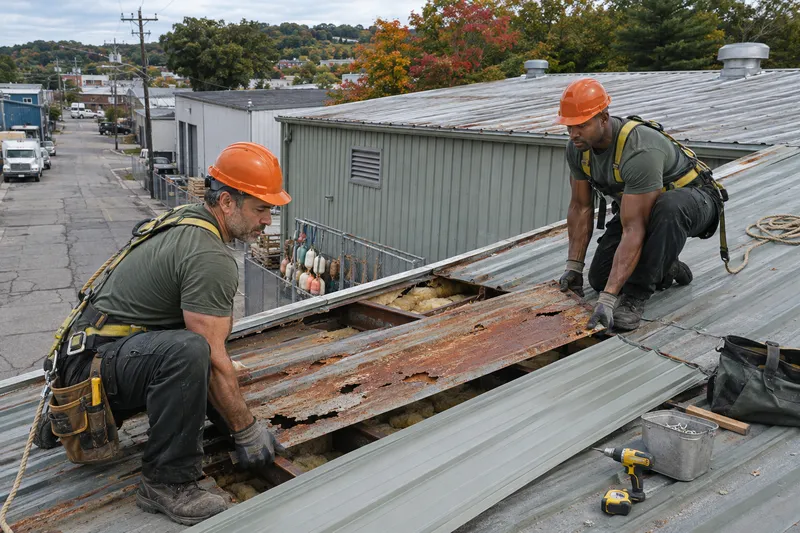
On steel buildings, traces often end at a screw row or lap, repaired with oversized fasteners and new sealant.
See commercial metal roof repair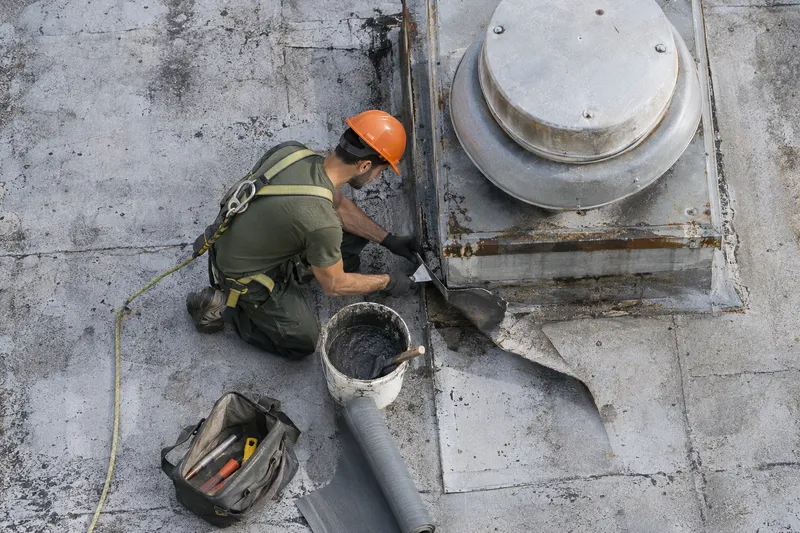
Leaks over production lines get traced and repaired in small sections with equipment covered below.
See industrial roof repairNo. A healthy commercial roof stays dry in any rain. Leaks that show up only in downpours or nor'easters usually point to drains that cannot keep up, open seams in low spots, or flashing that wind pushes water behind. Each of those is repairable.
Cracked curb flashing, open seams at the curb corners, failed counterflashing, or loose unit panels that let rain into the curb. Condensate lines draining on the roof wear the membrane too. Unit panels get checked with your mechanical contractor when needed.
Finding the leak is often the larger share. Cost depends on how many possible sources exist, how far water has traveled, the repair itself, the amount of wet insulation, and any interior protection. One failed curb corner costs less than several seams in a ponding area.
Water runs along the deck, purlins, and insulation joints until it finds a gap to drip through. On a low-slope roof that can be several feet from the entry point, which is why we trace upslope from the stain.
Call while the stain is fresh. Wet insulation spreads water sideways and grows the repair, and a recent stain is easier to match to the roof above it.
A temporary seal can go on during a break in the weather to slow the water. The permanent repair waits for a dry roof, because patches, tape, and sealant need a clean, dry surface to bond.
Tell us where the stain shows and when it appears. We will trace the water to its source and price the repair.